

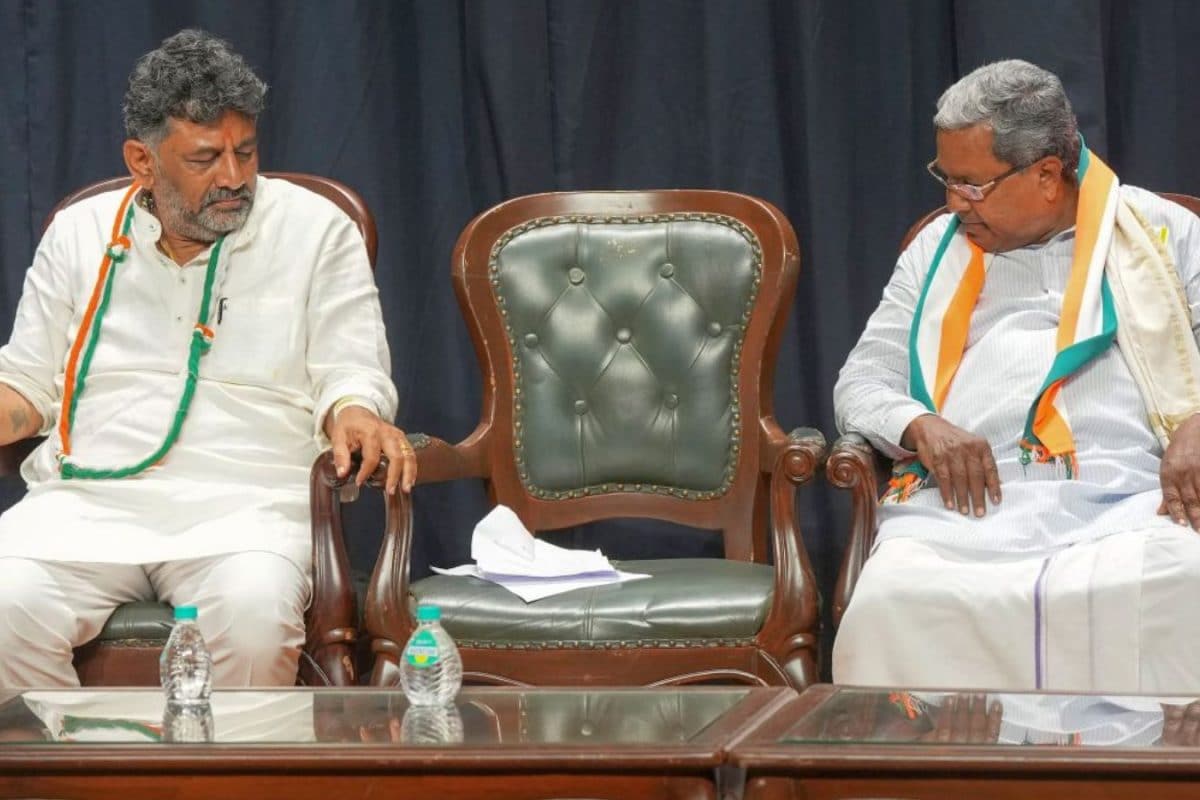
‘Will It Be Siddaramaiah Or Shivakumar? Never Mind’: How The Karnataka Reset Buzz Flatlined
For months, political circles in Karnataka were consumed by speculation over a possible leadership change in the state government — a debate centred on Chief Minister Siddaramaiah and Deputy Chief Minister D. K. Shivakumar. But despite persistent rumours, internal calculations, and media buzz, the anticipated “Karnataka reset” now appears to have largely lost momentum.
What was once projected as a potentially dramatic power transition inside the ruling Indian National Congress has gradually flattened into political background noise, with the party leadership showing little urgency to alter the existing arrangement.
The Origins Of The Power-Sharing Speculation
The leadership debate began soon after Congress secured a decisive victory in the 2023 Karnataka Assembly elections. Siddaramaiah was eventually chosen as Chief Minister, while D.K. Shivakumar — widely credited for the party’s organisational strength in the state — was appointed Deputy CM.
From the outset, speculation emerged about an alleged rotational power-sharing formula, with rumours suggesting Shivakumar could take over midway through the government’s term. However, neither the state leadership nor the Congress high command publicly confirmed any such formal agreement.
Still, periodic political statements, strategic silences, and lobbying efforts kept the issue alive in political discourse.
Why The Buzz Has Slowed Down
Several factors have contributed to the cooling of the leadership-change narrative:
Stability Over Experimentation
The Congress leadership currently appears more focused on political stability than internal reshuffling. With important electoral battles ahead, including national and local elections, the party seems reluctant to risk administrative disruption or factional instability in one of its key southern strongholds.
Siddaramaiah’s Administrative Grip
Siddaramaiah has continued to maintain a strong hold over governance and welfare delivery. His government’s flagship guarantee schemes and budgetary initiatives have helped consolidate his position within the party and among sections of voters.
The absence of any major governance crisis has also reduced immediate pressure for leadership change.
Shivakumar’s Continued Influence
At the same time, D.K. Shivakumar remains one of the most influential Congress leaders in Karnataka. Beyond his role as Deputy CM, he continues to control significant organisational networks and political resources within the state.
Rather than open rivalry, the current arrangement increasingly resembles a carefully managed balance of power between the two leaders.
Congress High Command Avoids Public Signals
The national leadership of the Indian National Congress has consistently avoided giving clear public signals about any future transition. Senior party figures have repeatedly stated that the government is functioning effectively and that speculation over leadership changes is unnecessary.
This strategic ambiguity may itself be intentional — allowing both camps to remain politically invested without triggering open confrontation.
Political Optics Matter
For the Congress party, maintaining unity in Karnataka has broader national importance. Karnataka remains the party’s most significant state government after several setbacks in other regions. Any visible factional conflict could weaken the party’s governance narrative and offer political opportunities to rivals like the Bharatiya Janata Party and Janata Dal (Secular).
As a result, the once-heated question — “Will it be Siddaramaiah or Shivakumar?” — now seems less urgent within the party structure.
The Reset That Never Came
While political speculation may continue periodically, the larger “reset” narrative appears to have stalled. Both Siddaramaiah and Shivakumar continue to operate within a negotiated political framework that, at least for now, serves the interests of the party leadership.
In Karnataka politics, leadership equations can shift quickly. But at present, the Congress appears more interested in preserving equilibrium than reopening a potentially destabilising succession debate.